Wednesday, January 30, 2013

Rise in Cyber attacks on government website threatens E-governance


Ben Uzor Jr

Efforts by federal government to promote the adoption of the internet for delivering government information and services to its citizenry is been threatened by the recent spike in incidences of cyber attacks on websites of ministries, departments and agencies (MDAs) of government, experts have said. E-Governance, according to industry experts strengthens the very fabric of democracy by ensuring greater citizen participation at all levels of governance.

In the preceding year, cyber criminals attacked prominent government websites including the Economic and Financial Crimes Commission (EFCC), the Central Bank of Nigeria (CBN) and the Ministry of Science and Technology (MST). This trend, according to industry analysts is expected to continue in the new year. It is also particularly worrying because Nigeria still does not have requisite legislation to protect data, Information Technology (IT) infrastructure and prosecute perpetrators of cyber crimes.

Ernst & Young has estimated that the Nigerian economy loses $200 million annually to cyber crime. Omobola Johnson, minister of communication technology has at various stakeholder fora expressed federal government’s desire to strengthen e-governance in the country, further predicting that by 2015 all MDAs will have effective websites. Though, there has been some level of progress in that regard, government's efforts, according to industry analysts could be negated by the growing incidences of online attacks on government websites.

The number of MDAs with effective websites increased from 370 in 2011 to 420 in 2012, according to statistics from the ministry of communications technology. Besides, the number of cases involved with the defacement of government websites in Nigeria has continued to rise from 10 percent back in 2010 to 60 percent as at 2012, reports Centrex Ethical Lab, a cyber-security and intelligence company based in Abuja. But interestingly, the data shows that there has been an increase in cyber-violations of official websites of government agencies over the last three years.

A total of 23 official government websites (.gov.ng) were reported defaced in 2012 alone, out of a total of 60 website defacements during the year, including 15 cases of violation of .org government websites. "e-government is endangered without a National Cybercrime Act", Chris Uwaje, president, Institute of Software Practitioners of Nigeria (ISPON) told Benuzorreports in an interview. But there is hope. He disclosed that the Chairman Committee on Science and Technology was in Malaysia, november last year with the director-general of the National Information Technology Development Agency (NITDA), Cleopas Angaye to explore the modalities for a national Framework for Cybercrime Bill.

"The bill should be passed this year", he said. David Mbah, an industry analyst told Benuzorreports, that the increase in the number of cyber attacks in recent months poses multiple threats to government's e-governance initiatives. "Data security is a key concern in e-governance as the system of manually maintaining records has been gradually replaced with digitisation of data"."Maintaining high-level security is imperative in e-governance. If the system is not secured and hacked, the government will not be able to function smoothly,” Mbah further added.

When BusinessDay reached out to government officials in CBN, EFCC and ministry of science and technology for comments, they all declined, claiming that they were not authorised to speak on such matters. Experts pointed out that lack of knowledge was a critical reason for the vulnerability of government websites. Nsikak Nelson, a cyber-security expert said the lack of understanding of ethical hacking among many government officials is the main reason for the growing attack. Speaking in the same vein, Tim Unwin, chief executive officer of Commonwealth Telecommunication Organisation (CTO), has urged government to formulate legal and regulatory frameworks to minimise cybercrimes.

The Nigerian Communications Commission (NCC), according to him had a very critical role to play in this area. Cybercrime, especially website hacking has seen tremendous growth around the world as major banks  in the United States (US) were hit with the biggest cyber-attacks in history, as well as the Vatican website being hacked twice in one week last year. These cyber attacks are expected to increase in 2013 and beyond as cyber-criminals continue to think of clever and sneaky ways to obtain customer’s credit card data and personal data, as well as in response to unfavorable government policies and actions.   

Lack of broadband policy leaves N347bn undersea cables redundant


Ben Uzor Jr

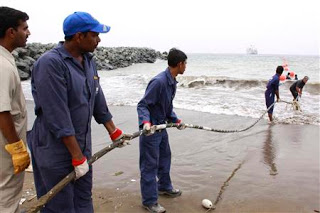
The delay in the approval of a national broadband policy for the country is threatening N347 billion ($2.24bn) investments in underwater cable systems, industry analysts have said. The broadband policy, according to industry analysts is expected to encourage infrastructure sharing and open up the broadband infrastructure market to foreign and local investors. This, they argue would facilitate the aggressive build out of requisite distribution and lastmile infrastructure needed to move available bandwidth capacity from undersea cables across the length and breadth of the country. A new report by the Oxford Business Group (OBG) showed that there are four active undersea cable firms, including Nigerian Telecommunications (NITEL), providing a total of 7.78 terabits per second of capacity. This, according to analysts is a major boost in the capacity available to drive bandwidth dependent services.

 Despite the enormous bandwidth capacity emanating from these cables, Nigerians are yet to benefit from the investments in the area of affordable and efficient broadband services. The 7, 000 – kilometre MainOne submarine, which went live in 2010 is valued at $240 million. The 10, 000 kilometre Glo-1 cable cost $800, 000 to build. Industry analysts place the worth of NITEL’s South Atlantic 3 (SAT 3) at about $600 million. While MTN’s West African Cable System (WACS), cost about $600 million. This means that the total investments and other expenses rose to $2.24 billion. Funke Opeke, chief executive officer, MainOne cable in an interview expressed dismay at the level of utilisation of these undersea cable infrastructures. She has at various fora advocated for a national policy on broadband to accelerate rapid penetration of the internet, lower cost of distribution and to speed up economic development.

About 5 percent of the capacity from the MainOne Cable is utilised, Opeke told Benuzorreports. This low utilisation of the international cable infrastructure is across board. This, according to industry analysts has implications for the Nigerian economy as new business opportunities such mobile applications development, Value Added Services (VAS), telemedicine expected to spring up as a result of the emergence of the cables are still non-existent. Usen Udoh, senior director, management consulting at Accenture Nigeria shares Opeke’s sentiments. He was quoted in a report as saying the continued delay in developing a national broadband policy to push the bandwidth to rural areas is currently bringing people's creativity to waste. “It is that broadband policy that would then be able to expand or ensure access into the hinterlands and then bring huge bandwidth that is on our coast to the hinterlands.

“Without that last mile connection, it is like somebody who just brought a huge pot of soup and put it in front of your house and there are no plates to go there and serve the food and bring them in.” Kazeem Oladepo, a member, Board of Trustees of the Association of Licensed Telecoms Operators of Nigeria (ALTON) believes a national broadband policy would go a long way in boosting broadband infrastructure build. Oladepo however blamed the low broadband penetration in the country on weak demand for broadband capacities by Nigerians. “Government must put all its services online, such that for anybody to access government information, the person must go online. For any civil servant to fill government form, the person goes online. By doing so, government would create demand for broadband access.

Giving his advice on what government needs to attract investment in broadband infrastructure, Oladepo said, "there are two basic issues to broadband penetration and they include access and demand. While access has to do with the level of the infrastructure rollout that will enable everyone have access to broadband, demand in itself depends on the need for broadband by the citizens, which has to do with creating awareness on the part of the citizens in order to expose them to the importance of broadband.” Oladepo said the prices have actually crashed at the wholesale international connectivity level but that reduction in prices had trickled down to the end user. This, he added was because the gap between the wholesale and retail services has not been adequately bridged through infrastructure, which delays access and generally hinders end users from benefitting in corresponding proportion on the radical price reduction, combined with superior services quality. “Few years back, we bought IPLC bandwidth off NITEL at rates that were close to $1,500 per Meg. Today, you can buy the same capacity at between $300 and $500, depending on the volume and duration of service you are buying.”

Friday, January 4, 2013

Mobile number portability testing gets underway


Ben Uzor Jr

The Nigerian Communications Commission (NCC) is making significant progress in its quest to commence the much anticipated Mobile Number Portability (MNP) scheme in the first quarter of 2013. The MNP scheme would enable Nigeria’s over 100 million telephone users to retain their mobile phone numbers should they choose to migrate from one mobile network operator to another. Sources close to the commission told BusinessDay that testing of the system had actually begun in December, but was slowed down by the Christmas and New Year holidays. Our source said testing is to re-commence next week, to smoothen out the rough edges  in the scheme and provide ample opportunity for consultants to address any hitches that may arise in the process, before the launch.

BusinessDay gathered that from a technical perspective, MNP providers have already begun integrating with telecom providers’ Operation Support Systems (OSSs) and internal business processes, such as customer care, billing and other management systems. Osondu Nwokoro, director, regulatory and government affairs, Airtel Nigeria, told Business Day, “We are ready for the commencement of the scheme in the first quarter of 2013. We only hope that others will not frustrate the process. One of the benefits of the scheme is that it would assist the NCC in regulating the industry properly. Number portability will address quality of service issues and high tariffs. Number portability will make it easier for the regulator to manage anti-competition practices. A lot of such practices are cropping up in the industry.

“It will drive competition in the industry because if an operator fails to provide good quality of service, a telecoms subscriber has the freedom to switch to another network. It will definitely encourage all telecoms operators to provide services at an optimal level. Industry watchers are optimistic that the scheme would not only foster competition in the industry, but also throw up fresh opportunities for value added service providers, as networks with poor service quality will have difficulty retaining customers when the scheme takes off.

Wale Goodluck, corporate services executive, MTN Nigeria, told Business Day: “The scheme will drive value along customer relations, innovative product offerings and value added services. It can only be good for Nigeria’s telecoms industry. We are aware that the scheme will go live in the first quarter of 2013. In view of this, we are prepared and looking forward to the commencement of the scheme. As I speak, all systems are ready to go. I think mobile number portability will empower the subscriber”. BusinessDay gathered that telecoms operators will have to invest significant resources in network expansion and upgrades, develop innovative value added services to keep their subscribers from migrating to other mobile networks. In March 2012, a consortium of three firms had won the bid to operate the scheme. The firms that make up the consortium are Interconnect Clearing House Nigeria (ICN) Telecordia of the USA and Saab Grintek of South Africa.

Bill Best, former chief technical officer, GSMA in an interview said that “the scheme represents an opportunity for Nigeria’s telecoms industry to progress and develop by breaking down one of the biggest impediments to customer choice - number lock-in”. Best said the scheme has been proven to increase market activity and revenues, as it gives an overall boost to all service providers in the marketplace. Tony Ojobo, director, public affairs, Nigerian Communications Commission (NCC), has at several fora reiterated the commission’s commitment to commence the implementation of number portability across all networks before the end of the first quarter of the year.

He was quoted in a news report yesterday, as saying the scheme would foster healthy competition in the industry, as operators would not want to lose their customers to other networks. Number portability gives subscribers the option of migrating from one network to another at will, while in search of better service quality. “Apart from competition, which will bring healthy rivalry among operators, they will also be forced to introduce value-added services that will attract customers to their networks, and also retain existing subscribers.

“ Explaining the rationale behind the number portability regime, Ojobo said recently, “We needed to change the tactics. We needed something new and creative, we needed something tasking, which will make the operators stand on their toes and address the challenges of quality of service faced by consumers in their various networks. “The NCC needed to empower the consumers while they make the choice as to what network they wish to stay on.”

Mobile money transactions to hit N151 billion by 2015


Ben Uzor Jr
               
As Nigeria’s 16 mobile payment operators jostle to expand the scope of the market, the total value of mobile money transactions is expected to increase to N151 billion by 2015.The minister of communications technology, Omobola Johnson, made this known in a statement made available to Business Day, weekend. Total value of transactions on mobile money networks, according to her stands at N228 million. She also said the total volume of non-store shopping increased from N62 billion in 2011 to N77.5 billion in 2012. Industry analysts say non-store shopping is largely been driven by the Internet. The constant growth of the formal retail sector in Nigeria, along with rising internet penetration in the country, is driving the expansion of online retailing, according to the analysts.

Johnson however predicted that the figure for non- store shopping will increase to N658 billion by 2015. “Verified Mobile Money Agents currently stand at 3, 000 and expectations are that the number of agents will increase to 50,000 by 2015”. A new survey has revealed that only 400,000 Nigerians are registered with mobile money operators out of 28.6 million adults operating bank accounts in the country. The survey, which was carried out by Enhancing Financial Innovation and Access, stated that 4.8 million adults were aware of mobile money but 400,000 people actually have registration with mobile money agents. The figure however represents 1.4 percent of the bank account holders.

 This is a clear indication that mobile money service is still struggling to get a footing in Nigeria even with its huge potentials. Industry analysts say mobile money operators and banks have failed to clearly define the benefits customers can derive from using the service. The survey also shows that 0.45 percent of the total adult population in Nigeria use the mobile money facility. It further stated that mobile money was mostly used to buy airtime, with 32.9 percent of registered mobile money users buying airtime on the platform; while 28 per cent use mobile money to send money to people. According to the survey, 21.8 percent of users have the platform just to receive money from people.

 On the other hand, 17.4 percent use it to pay bills. Meanwhile, the Central Bank of Nigeria (CBN) has directed the 16 Mobile Money Operators (MMOs) in the country to fully connect to the National Central Switch (NCS) before Feb. 28, 2013. The CBN gave the directive in a circular entitled “Timeline for Interoperability and Interconnectivity” on Friday. The circular was signed by Dipo Fatokun, CBN’s director of banking and payment system. The circular stated that full connection to NCS would enhance MMOs’ “inter-operability and interconnectivity“. The apex bank said the decision for all MMOs to connect to NCS was reached at the Mobile Payment Forum held on Nov. 29. It added that “for avoidance of doubt, appropriate sanction will be imposed on any mobile payment operator that fails to comply with the circular.”

Nigerians starved of broadband amid international capacity glut


Ben Uzor Jr

Despite the enormous bandwidth capacity sitting on the country’s coastline, majority of the Nigerian populace are been starved of broadband Internet, Funke Opeke, chief executive officer, MainOne Cable Company told newsmen in Lagos recently.  At the moment, there are four active undersea cable systems ((MainOne Cable, Glo-1, MTN’s WACS and NITEL’s SAT-3) in the country. The existing submarine cables in Nigeria carry an installed capacity of over 19.2 terabytes, about 340 gigabyte combined, a significant increase in the capacity available to drive bandwidth dependent services. Opeke, however pointed out that only about five percent of the bandwidth capacity available on MainOne cable is currently being utilised, leaving 95 percent of the capacity redundant but available for use.

Speaking at an interactive session with journalists, Opeke blamed the poor utilisation of the cable on the absence of distribution and last mile infrastructure required to move available bandwidth capacity across the length and breadth of Nigeria. If Nigeria is to enjoy the benefits of broadband, she said regulatory and legislative interventions were required to address these challenges. Nigeria’s telecommunications market, according to her requires a well-rounded infrastructure sharing framework to encourage new entrants and stimulate investments in broadband in order to harness its potentials for wealth creation and economic development. “We strongly believe that it’s something government can set up in less than 60 days. It does no require years of study”, she stated.

The cost of moving internet traffic from Lagos to Abuja, according to her is four times higher than the cost of moving the same level of traffic from Lagos to London. This, she went on is because operators with huge fibre infrastructure have not embraced infrastructure sharing. Besides, those who have offer services at unfair and prohibitive prices. “Looking at the cost and competition policy under the Communications Act, there is absolutely no need for that pricing mechanism. We need to have more infrastructure sharing. “If people who build the infrastructure are running it over public right-of-way, and have received tax concessions to build those networks, I see no reason for such pricing mechanism.

“If private sector has built the infrastructure, then they certainly should make it available to others operators and networks on a fair and non-discriminatory basis. The federal government has done nothing about this so far”, the MainOne CEO added. Business Day learnt that there is more than 30,000 kilometres of domestic fiber optic cables to connect those international cables to more than 50 percent of the Nigerian population. But from all indications access to them is so far discriminatory and inordinately expensive. This, according to industry watchers has inhibited access for most Nigerian schools, hospitals, government agencies, young professionals and small and medium businesses.